
A rational and analytic look at the world. … Usually.
Showing posts with label science. Show all posts
Showing posts with label science. Show all posts
Tuesday, May 24, 2016
Dealing with "Things Unseen"
Science deals with unseen things like black holes by developing a testable hypothesis, which essentially describes what we would expect to see if there were black holes. When we observe behavior which matches the prediction, the hypothesis is confirmed. If not, it is rejected.
Same for microwaves. When we observe behavior (thermal excitation of water molecules) consistent with energy transfer of microwaves, we confirm the theory!
Religion on the other hand, takes an unexplained thing and blindly asserts #GodDidIt. When the tests for god's existence fail, believers make up excuses for *why* it failed rather than reject the hypothesis. You're likely well aware of this method. The Bible provides many objective tests for the Christian god's existence, all of which demonstrably fail:
- Matthew 7:7 “Ask, and it will be given to you seek, and you will find; knock, and it will be opened to you.
- Matthew 21:22 And whatever you ask in prayer, you will receive, if you have faith.”
- Mark 11:24 Therefore I tell you, whatever you ask in prayer, believe that you have received it, and it will be yours.
- John 14:13-14 Whatever you ask in my name, this I will do, that the Father may be glorified in the Son. If you ask me anything in my name, I will do it
So as a devout Christian, the first time you pray for something and it doesn't come true, you can know that the Bible is wrong. However, instead of admit their assumptions might be wrong, religious people blame themselves ("I must not have enough *faith*!") or make empty platitudes ("God works in mysterious ways.")

Saturday, May 14, 2016
Geometry and a Flat Earth
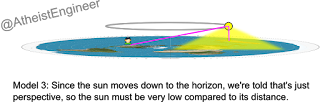
We're told that the sun disappears over the horizon for the same reason that airplane contrails reach the horizon (which ironically is due to them following the curvature of the earth). So let's consider perspective at night. According to a Flat Earther I asked, Australia is about 10k miles from the US in a Flat Earth model.
We know that:

We know that:
- $ \theta_{ele} = atan(h/d) $ Where h is the height of the sun off the flat earth and d is the distance to the sun's nadir point (directly below the sun).
- When the sun is over Australia, it's dark in the united states.
- It's 10,000 miles from US to Australia.
Flat Earthers generally report that the sun is 3000 to 4000 miles in elevation. This is probably because if you tried to triangulate the sun (at approximately infinity miles away) from a curved surface you erroneously believed to be flat, you'd find that it appears to be about $ r $ miles away.
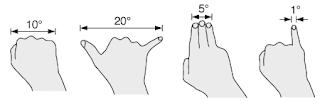
But how can that be?! $ atan(3000/10000) = 16.7 \degree $ !!. That's a pretty good elevation. About one and a half fists above the horizon! That would be pretty obvious!
Making the small-angle approximation, these angles and distances scale approximately linearly. To get as low as half of a fist above the horizon, we need 1/3 the height (let's say 1000 miles!). To get as low as one degree (still 2 sun widths) above the horizon, we'd need to be just 100 miles up. That's just at the edge of space. The sun could be hit with an amateyr rocket!!
With that, I've got no way to try to rescue this theory. The angles don't make sense. Anyone got a way to make this problem work?
Thursday, May 12, 2016
Collection of Satellite Images and Videos
I keep getting asked for pictures of satellites by #FlatEarthers I'm talking with. Rather than find them each time, here's a collection. The gif was from reddit.


Geostationary satellites in the Swiss Alps from Michael Kunze on Vimeo.
This guy wasn't even really trying, but when he co-adds frames (go make the streaking effect), it jumps right out.There's a clear GEO satellite near the top of the frame, about 40% in from the left.
A Starry Night of Mt.Kilimanjaro from kwon, o chul on Vimeo.
This photographer isn't taking exposures long enough and has too much city light to see the satellites clearly. The "flashes" are likely glints off the solar panels or an aliasing artifact in his video conversion. Longer exposures could cause streaking, but would bring the satellites out more clearly.
Geostationary Satellite Flashes, Night of March 7-8, 2013 from Ken Musgrave on Vimeo.
The folks at ExoAnalytic have some great professional videos through robotic telescopes.


Amateur Videos Showing Satellites
I'm not sure which satellites these are, but they're geostationary over Switzerland. This sort of imaging is surprisingly easy to do (this guy does it VERY well!). Just get a camera, a tripod, and take 5-10 sec exposures all night of the plane where the moon, sun, and planets pass. Stitch them all together and you'll notice that some don't move. Those are geostationary satellites. You can figure out which ones they are with a bit of extra math.Geostationary satellites in the Swiss Alps from Michael Kunze on Vimeo.
This guy wasn't even really trying, but when he co-adds frames (go make the streaking effect), it jumps right out.There's a clear GEO satellite near the top of the frame, about 40% in from the left.
A Starry Night of Mt.Kilimanjaro from kwon, o chul on Vimeo.
This photographer isn't taking exposures long enough and has too much city light to see the satellites clearly. The "flashes" are likely glints off the solar panels or an aliasing artifact in his video conversion. Longer exposures could cause streaking, but would bring the satellites out more clearly.
Geostationary Satellite Flashes, Night of March 7-8, 2013 from Ken Musgrave on Vimeo.
The folks at ExoAnalytic have some great professional videos through robotic telescopes.
Why not from other satellites?
I'm also often asked why we don't see satellites take pictures of other satellites. To someone naive about otbits, this might seem like an easier task. You're closer, right? No. Space is very big, and satellites moving 17,000 mph, not all in the same direction! Nevertheless, It's been done. An imaging satellite named Pléiades 1A took a picture of SPOT 5.
Tuesday, May 10, 2016
Comparing Flat Earth Models to Reality
I finally found a video which helped me understand the flat-earther model of a sun circling a flat earth. Thanks to p-brain for helping me out here.
Setting aside his disastrous misunderstanding of perspective, he has a decent point regarding how distant points converge at long distances. The "plane" that the sun would orbit within would indeed appear to approach (though never quite cross) the horizon.


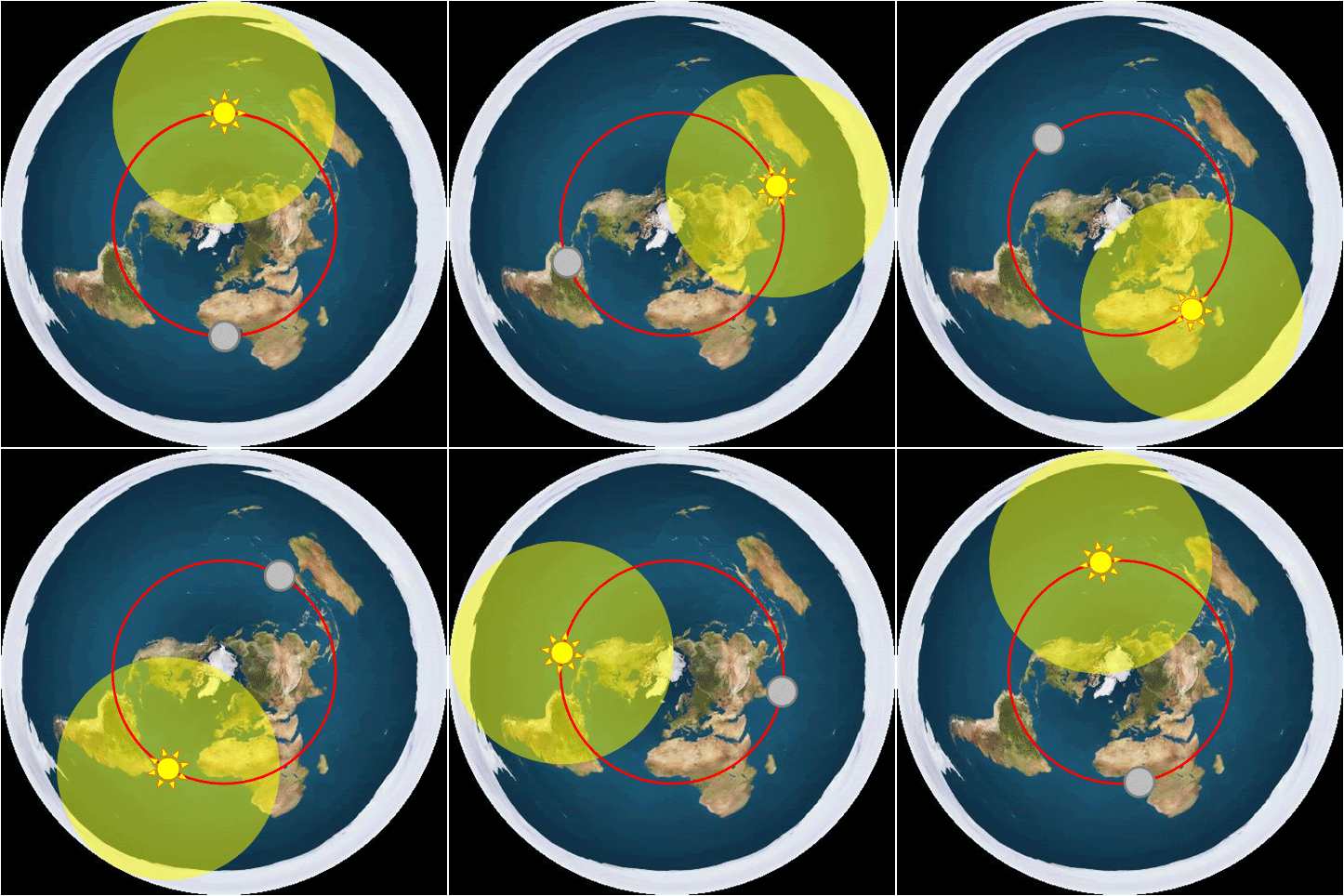
I suspect this claim falls apart when we start examining distances necessary to accomplish this. Clearly the Sun isn't flying along at 30,000 ft like the contrails p-brain uses as an example. Rather, it would need to be flying a minimum of 2-3x higher. My intuition is that the angles will come closest to working if we set the sun at an altitude equal to the radius of the earth (4000 miles) .
So let's compare the two approaches. For the sake of simplicity, I'll assume the curvature of the sun's path is so slight that we don't notice it curving northwards. That's right, I'm going to give the Flat Earthers a pass on the fact that we don't see the sun curving to the north! No "Where's the curve?!" from me.

So anyways, the distinction is really easy to make. If you believe in a Flat Earth, simply measure the angle to the sun throughout the day and compare the following plot of arctan(1/x):
If it's straight, the angular rotation is constant, which matches the spherical earth model:

- If the solar angle matches the plot of $ arctan(1/t) $, then it's a flat earth.
- If the solar angle is a straight line, it's a sphere.
Note: The angle you need to measure is called the "Right Ascension" (RA). Align a pole to point to the North Star at night. Measure the angle to the sun about this pole. This could be done with a protractor oriented perpendicular to the pole on the back side (away from the sun). Note the angle where the shadow is cast. Here's my attempt to draw the experimental setup.

Saturday, April 30, 2016
Flat Earth Misconceptions
I'm so tired of repeating myself to Flat-Earthers. It's like they revel in doing their math wrong, but there's not enough characters in twitter to send them the proper equations. So I'll address a few classic pics here to explain how it's done.
 Here, we have the classic flat-earther example of a "mountain that's too far away to see." First, let's check the facts. After a bit of digging, I figured out that they're claiming this is Mt. Denali. That's 140 miles away, with an elevation of roughly 20,000 ft.

It's actually 700 ft at the summit of the Hilltop Ski Resort, but it turns out that won't matter in the end. 

Even the most casual thought regarding this picture and you'll realize that since the sun is above a flat earth, you'll be able to see it at all times from any location on earth. Turn this model on its side and draw a vector from any point on earth to the sun and you'll see that it never sets. The figure below shows this and explains the problems.

If there's some other way to interpret the animation above, I sure can't think of it. Send me a comment or tweet to help me understand.
I'm left wondering if flat earthers lack all spatial reasoning. It sure seems that way.


The distant mountain picture
This is a favorite among flat-earthers, and it's pretty easy to show they get the math wrong. Someone told this guy that he can use a simple linear fit for earth's CURVED surface (8 inches per mile or some such tripe). I'm not sure where this approximation came from, but it obviously doesn't fit a curve very well. Anyhow, here's an example:


Anyhow, let's assume they're right and it's Denali. First, calculate the distance and angle to the horizon from an elevation of 700 ft. I'll let WikiHow explain how to do it. I'm using the arccos formula:
$ d = r \arccos(\frac{r}{r+h}) $
The horizon from Hilltop is calculated here at 32 miles.
The horizon from Denali is calculated here at 174 miles.
Suppose the picture were taken from the parking lot of Hilltop instead of the top. The horizon is still 27.5 miles away, well within the range of Denali's summit.
32 + 174 means you can see the tip of Denali from as far as 206 mi at an altitude of 700 ft (assuming there's no mountains in between and neglecting atmospheric lensing, of course). This is obviously not a problem for observation from 140 miles away.
Just for convenience, we could figure out how tall an object needs to be to see it from a distance, x. We simply add the horizon distance to the solution to our first equation for h:
$ \cos( \frac{d}{r} ) = \frac{r}{r+h} $
$ h = \frac{r}{cos(\frac{d}{r})} - r $
Just for convenience, we could figure out how tall an object needs to be to see it from a distance, x. We simply add the horizon distance to the solution to our first equation for h:
$ \cos( \frac{d}{r} ) = \frac{r}{r+h} $
$ h = \frac{r}{cos(\frac{d}{r})} - r $
Time Zone Solar Models
This is another flat earther hand-waving explanation for time-zones.


I'm left wondering if flat earthers lack all spatial reasoning. It sure seems that way.
Pilots Would End up in Space!
This one is so bizarre that it takes a little work to wrap your head around. Essentially, the argument is that airline pilots would need to adjust their elevation by 1 degree every 6 or 7 minutes to keep from climbing higher and higher and crash into the firmament or flying into space. There's some specious assumptions here:
- That airplanes fly along laser-like straight lines
- Airplanes will continue climbing at the same rate for a given angle of attack even as the air thins.
- That the pilot has the sensitive equipment to recognize one-degree drift over 6 minutes
In the same way as you might make minor course corrections along a straight road to keep your car centered in your lane, the autopilot (or the real pilot) is constantly adjusting to maintain a reasonably constant altitude and heading. These corrections are happening at a rate of tens to hundreds per minute. To the pilot or autopilot, this feels like maintaining altitude. In reality, it's conforming the flight to the curvature of earth. This publication described the typical roughness of a commercial flight. I've pulled out the "rough cruise" section because the constant readjustment of altitude is more clearly apparent. Same thing happens in "smooth cruise", but more gradually.

Simple computer models can help us understand when and where we'll be able to observe curvature of a sphere. The key factors which affect the appearance of curvature are:


- Altitude above the surface
- Camera Focal Length (or field of view)
- Radius of the sphere
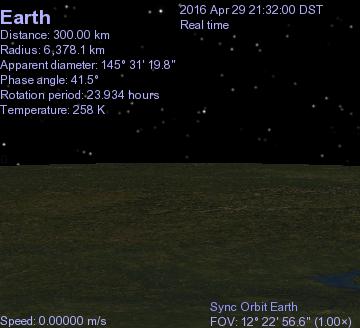
I'm sure someone could write an expression for the apparent curvature versus these parameters, but it's easier to just show you. I'm using an open-source tool called Celestia which accurately presents the position, sizes, and velocities of celestial objects. I highly recommend it. It's fun to play with.
Changing the Field of View
Here's the same view as the Field of View is altered. This is like zooming out on your camera. The FOV is reported in the bottom-right while the location (constant) is presented in the upper-left.


Changing the Altitude
This one is a little more obvious. As you move to higher and higher altitudes, the curvature becomes more apparent.

Note that the Distance is 30 km. That's a decimal place, not a comma.

Radius Matters Too
This one is just for fun. Here's some spheres of different radii from the same distance.

Mythbusters are shills?
Well, as we've shown, the curvature isn't expected to be visible at low altitudes. Here's Adam Savage at a 12 mile altitude witnessing the curvature for himself. So I suppose he's got to be a liar now, eh?
The Moon / Spinning Earth can't be felt!
Moon: The gravitational acceleration of the moon on the surface of earth is given by $ a = G m_{moon}/r^2 $ or roughly $ 3.6 \times 10^{-5} m/s^2 $ compared to the $ 9.8 m/s^2 $ I measured in high school for earth's gravity. That's less than one part in a million. A hard thing to measure.
Rotation: The acceleration of an object on the equator due to circular motion from the rotation of the earth is given by: $ a = \omega^2 / r $. This also tiny at $ 0.034 m/s^2 $. This effect (0.34%) MIGHT be measurable by exceptionally sensitive equipment and a skilled scientist, but these are the sorts of people the Flat Earth crowd seems to consider untrustworthy.
Edit: I fixed my math above. Rotation is actually much more important than I originally calculated. Thanks to @TheOlifant for catching my error:
@haplesspete @AtheistEngineer Thanks for the link! That's a great read. 1 q.: Where is my mistake in this? pic.twitter.com/3M6QtVGG37— The Olifant (@TheOlifant) May 2, 2016
Mentality
The mentality of flat-earthers seems to be very similar to that of anti-vaxers and deeply religious. The believer thinks they've figured out that most of humanity is wrong, and that their answer is the right answer. They often tell you to "research it," and couple commands with insults "stupid" or "dummy" or "sheep."
These believers think they've figured out what "they" don't want you to know. The "they" varies between people, but it seems to be illuminati, the government, or the Free Masons. For devout Christians or Muslims, the "they" is Satan, heretics, or demons.
These believers pride themselves in being different. They think they're visionaries for knowing the truth when everyone else has it wrong. Despite having no formal training in the specific scientific claims they reject, they feel sure that all the professional scientists have been deceived by the "they."
What's particularly interesting is that these people seem to blindly follow (IMO obvious) quacks. Some guy with a YouTube channel is seen as more reliable than all the world's scientists. They wave off these brilliant scientists by presuming they've never actually TESTED any of the claims they learned in science text books without seeming to notice that:
What's particularly interesting is that these people seem to blindly follow (IMO obvious) quacks. Some guy with a YouTube channel is seen as more reliable than all the world's scientists. They wave off these brilliant scientists by presuming they've never actually TESTED any of the claims they learned in science text books without seeming to notice that:
- The YouTube quack has never tested his flat earth claims. At best their "evidence" seems to be that they find actual physics hard to understand or inconsistent with scripture.
- Scientists actually do verify the basics. They build more complex experiments on top of them, so if the basics weren't right, nothing would work.
Thursday, March 10, 2016
Response to Evolution "News"
I don't know why I wasted my time. My edits are in bold italics. Response to
http://www.evolutionnews.org/2015/09/waiting_for_mut099631.html
http://www.evolutionnews.org/2015/09/waiting_for_mut099631.html
Many(hardly any) scientists now recognize the insufficiency of the classic Darwinian story to account for the appearance of new features or innovations in the history of life. They focus on other theories to account for remarkable differences between genomes, the appearance of novel body plans, and genuine innovations like the bat's wing, the mammalian placenta, the vertebrate eye, or insect flight, for example (In the same way that General Relativity improved on "Newtonian Theory" and made Mercury's orbit work?).They realize(Inspired by their religion, they believe) that the traditional story of population genetics (changes in allele frequencies in populations due to mutation, selection, and drift) cannot account for "the arrival of the fittest" and not just the "survival of the fittest." (Hugo DeVries, 1904). <-- Wow, they're reaching DEEP into the historical academic workOne of the reasonsHere's where they deliberately misinterpret journal results and compare apples to oranges to make the reader think there's something wrong with science. At its core, this is part of a larger argument from ignorance approach, paraphrased as: 'Science isn't right. Therefore God did it.'many(this tiny fraction of )scientists acknowledge the insufficiency of Darwinism is because theyknow therefuse to admit that the accountingwon'tworks. The mutation rate, the generation times, the strength of selection versus genetic drift, the population sizes, and the time availabledon'tmatch up just fine.
For example, supposedly humans last shared common ancestry with chimps about six million years ago. Since that time, we have accumulated significant differences with chimps -- genetic, anatomical, physiological, behavioral, and intellectual differences, among others. The genetic differences between humans and chimps are much more than the (shrinking) 1.2 percent difference in base pairs that is so often quoted in the media. (Yes, there are different ways of measuring similarity.) Add small insertions and deletions and the differences climb to about 3-5 percent,depending on whose estimate is used. Add another 2.7 percent for large scale duplications or deletions, another 6 percent for new Alu elements (a kind of mobile genetic element) and some unknown number for rearrangements of the DNA, other insertions of mobile genetic elements, or new genes, we have more than 11.7 percent of our genome with unique features not present in chimps. (Only when you struggle to exaggerate moves and deletions. For reference, here is the preliminary analysis as published in Nature.)
There is only so much time for these differences to have accumulated. Mutations arise and are propagated from generation to generation, so the number of generations limits how many mutations can accumulate. The estimated mutation rate is about 10-8 per base pairs per generation, and we have an average generation time of somewhere between 10 and 25 years. Our estimated breeding population size six million years ago is thought to have been about 10,000 (these are all rough estimates based on numbers currently in use -- see the papers cited below). Based on these numbers, one can estimate how many years it would take to acquire all those mutations, assuming every mutation that occurred was saved, and stored up. (Since the mutation rate is extremely small and uniformly distributed, this assumption is valid.)
But there's a difficulty -- it's called genetic drift. In small populations, like the 10,000 estimate above, mutations are likely to be lost and have to reoccur many times before they actually stick (WTF? It's not like a specific change keeps trying. Many are just lost). Just because of random effects (failure to reproduce due to accidental death, infertility, not finding a mate, or the death of all one's progeny), a particular neutral mutation may have to arise many times before it becomes established in the population, and then many more years before it finally becomes fixed (that is, before it takes over the population and replaces all other versions).What a strange misinterpretation of the process! The author seems to think that the mutations which fail to reproduce keep trying until they stick. Bizarre! Clearly, lost mutations are simply lost. Just like the 99.9% of all species which have gone extinct. Very few succeed.
How long before a single, new mutation appears and becomes fixed? An estimate from a recent paper (by a Young Earth Creationist) using numerical simulations is 1.5 million years. That is within the range of possibility. (By assuming that there is only a single specific desirable mutation being considered by nature at any given time.) But what if two specific mutations are needed to effect a beneficial change? Their estimate is 84 million years. Other scientists have done this calculation using analytical methods, but their numbers are even worse. One report calculates 6 million years for one specific base change in an eight base target typical of the size of a DNA binding site to fix (In the abstract, the author points out that the sequence needn't be perfect to be valuable, reducing the time to 60,000 yrs), and 100 million years to get two specific mutations. (That work was later amended to 216 million years.) Extrapolating from other published data merely confirms the problem.Astonishing dishonesty! A brief review of the linked article (100 million years) contains the following quote: "Fortunately, in biological reality, the match of a regulatory protein to the target sequence does not have to be exact for binding to occur. Biological reality is complicated, with the acceptable sequences for binding described by position weight matrices that indicate the flexibility at different points in the sequence. To simplify, we assume that binding will occur to any eight-letter word that has seven letters in common with the target word. If we do this, then the mean waiting time reduces to ∼60,000 years." Why would Evolution "News" need to misrepresent the author's conclusions in their linked article? Did they think nobody would read it?
Durrett makes a good analogy to the mistake Michael Behe made to reach is 216 million year figure in the linked article: "Behe is not alone in making this type of mistake. When Evelyn Adams won the New Jersey lottery on October 23, 1985, and again on February 13, 1986, newspapers quoted odds of 17.1 trillion to 1. That assumes that the winning person and the two lottery dates are specified in advance, but at any point in time there is a population of individuals who have won the lottery and have a chance to win again, and there are many possible pairs of dates on which this event can happen. The probability that it happens in one lottery 1 year is ∼1 in 200 (Durrett 2009)
Another paper came up with much shorter time frames by assuming that any 5 to 10 base pair binding site could arise anywhere within 1 Kb of any promoter within the genome.
Yet in all likelihood many more than two binding sites would be required to change anything significant, and those binding sites must be appropriate in location and in sequence to accomplish the necessary changes. They must work together in order for a specific adaptive change to happen. (Again, the authors seem to think that these changes are prescribed and can't be happening at random, in parallel, and at different sites.)
Genes operate in networks, and to shift a gene regulatory network would require many mutations, and not just random ones. Remember there are anatomical physiological, behavioral, and intellectual differences to explain, multiple traits each requiring multiple coordinated mutations. Unless one invokes luck on a large scale, those traits would not have come to be. (Again, all this presumes humanity is the intended end-state. It is because it is.)
I'm not betting on luck. (Of course you're not).
Image: Homo georgicus, reconstruction, photo by 120 (Own work (photograph), model by Élisabeth Daynes) [CC BY-SA 3.0], via Wikimedia Commons.

Well that was as much fun as beating my head against a wall. The basics mistakes are as follows:
- Cite ancient journals from 1904 as if they're still relevant
- Misrepresent the number of changes
- Cite letters to journals which explicitly refute the point you're claiming they make (oops?!)
- Presume that the genetic changes were prescribed
- Assume intelligent humanity was the universe's desired end-goal
- Ignore that a neutral genetic change will not survive without a second change that's necessary to the benefit. Indeed, we could have millions of such single-mutations waiting on a second mutation to confer a benefit.
Sunday, March 6, 2016
Genetic Engineering Algorithms
Why do I care?
In discussion with creationists, I'm often told that "randomness cannot design."
No. ToE is based on random mutation... Randomness cannot design. @StuDiligence @BigBangOrBigLie pic.twitter.com/M8JNnJ2lqR— Rabid Dan (@DanThaWildMan) November 19, 2015
@DrJ_WasTaken— Preacher (@_OnlineGospel_) November 4, 2015
Flight cannot arise gradually with random mutation/natural selection@apostolicfdn @DynoJJ @RJDownard @TamiHoshiyama
 That's utter bullshit. One of the ways I reply to these tweets is with examples of Genetic Design Algorithms, where random mutations coupled with selection and reproduction based on objective performance criteria
 In the course of these conversations, I've dug up quite a few resources and developed a few memes.
Evolution Works
It works so damn well that it can be used to design things when you're not sure what approach is best. I'm not just saying that, there's really good examples:
- Field -Programmable Gate Arrays (FPGA's) have been designed to distinguish sounds.
- There are countless other examples in the literature of successful genetic design algorithms dating back over 20 years.
- There are commercial software products like Genetic Designer and Natural Selection which provide tools for genetic design
- Open-source libraries are free and available, so you can study the techniques and evaluate the performance for yourself. Admittedly, most of the people don't have the technical expertise, time, or patience to learn how to use these tools.
Watch it Happen Yourself
There are some really great examples of genetic design algorithms which can be watched evolving in near-real-time. One of my favorites is called BoxCar2D. In it, you can watch randomly designed cars compete for speed and distance. Successful cars reproduce with random mutations. You can even manipulate the mutation rates and number of top cars to breed. BoxCar2D is a pretty robust simulation,There are other, simpler online examples of the same basic concept. Since they're simpler, they converge faster:
- Genetic Algorithm 2D is a version that runs on pure HTML5 / javascript, so you don't need Flash.
- Genetic Cars lets you cross-breed your cars with cars from other online players.
- Darwin Bots is a more comprehensive simulation that runs on your desktop
- BioMorph is a simulator where the user interactively selects the successful child in each generation.
I'm sure there are more. If you have a personal favorite, please post a comment or tweet me.
Wednesday, August 12, 2015
The Good News of Atheism

What's the Good News of Christianity?
Note: When the Christians deliver this message, it focuses on the positive parts, and skips over the absurdities. I assume you've heard the whitewashed message so often that a deliberately jaded and cynical perspective is appropriate to help provide some "balance".In this story, their alleged god becomes human, then tortures and kills himself in order to generate a loophole in the morality he originally created. Christians say the "Good News", is that if you just BELIEVE in their claims and beg their invisible god for forgiveness, you can exploit this "moral" loophole and avoid eternal torture that/ awaits you after death. Only this god doesn't really manifest anywhere you can point to, so this begging for forgiveness happens (conveniently) at their church and to a large ironic idol, like the ones forbidden in Exodus 20:4.
"What do I need forgiveness for?" you may rightly ask. It turns out Christian doctrine teaches that humans are all wretched creatures deserving of eternal torture. They're not permitted to acknowledge how strange it is that a perfect being would create such a horrible failure of a species. "Free will" somehow plays a role in absolving god of his design failure. Chief among your "crimes" is not acknowledging and groveling before the theist's church (which stands in the place of the conspicuously absent god you're actually supposed to worship). Nevermind that this god failed to give you senses capable of detecting his presence. Nevermind that no scientific instrument has ever detected a god or its effects on the natural world. None of that matters. The blame for your failure to accept and worship the unseen god lands squarely on your shoulders. Refusing to accept the theist's claims that this god exists and deserves worship means you are arrogant and rebellious against their god.
So what is the good news of Atheism?
I put this question to my followers on Twitter:
I'm starting a blog post on the #GoodNewsOfAtheism.
What things did you feel were a relief when you left religion?
— Ατηξιsτ Εngιnεεr (@AtheistEngineer) July 21, 2015
What emerged was an outpouring of positive messages about atheism and what it means to people. It was a wonderfully uplifting day, and I'm delighted to be able to share it with you. There were so many wonderfully positive messages of freedom, relief, and empowerment. I captured many, but not all. I'd highly recommend reading the thread. I find it uplifting.
Corporal Punishment is as Immoral as it Feels
"Spare the rod, spoil the child" was an edict for many of my followers in their youth. This is a doctrine that feels good to dispose of. Physical punishment feels like poison.
@AtheistEngineer The list of painful realizations about my upbringing is substantial. I don't accept corporal punishment as moral, now.
— Pascal's Bookie (@DynoJJ) July 21, 2015
There is no Eternity to Worry About
Sure you'll hear from Christians that you ought to believe "just in case". But Pascal's wager is a fool's errand. Belief isn't a choice, it's a realization. And pretending to believe "just in case" wouldn't fool an omniscient god anyways.
- Heaven and hell almost certainly don't exist
- No just god would force a decision before you die.
@AtheistEngineer Knowing that the hell vs heaven story is all bullshit. Feeling free to seek out knowledge without worrying about sin.
— Lucas (@lucasbiccas) July 21, 2015
Let Go of Irrational Fears
There's so much additional baggage associated with Christian doctrine. The "mark of the beast" has been so played up that it hardly bears any resemblance to the passing mention it gets in the Bible.
@AtheistEngineer This going to sound silly (and it is) but one thing I was relieved about was no longer having to be afraid of the # 666.
— DeityFree 2.0 (@DeityFree) July 21, 2015
Similar things could be say about other recent additions to Christian doctrine. Much of our shared vision of "hell" comes from Dante's Inferno. Satan's portrayal in books and movies has had huge influence over our thinking. The Bible makes no claim that Satan barters souls in exchange for granting wishes. These are all modern inventions of fiction, adopted into our shared cultural memes.
Sometimes, God is just as scary as that Satan thing!
@atheistengineer Christian for 25 years, son of a theologian. Feeling "watched" by God had put me on anxiety medication. Finally feel free.
— EvolutionisBeautiful (@WyattWelsh) July 21, 2015
God is not Judging You for Thoughts
You are your harshest critic. There's no supernatural deity judging you for your thoughts. You're alone with them. They're yours and nobody knows them without your permission.
@AtheistEngineer Not feeling guilty and like I have to apologise for my thoughts and emotions. #GoodNewsOfAtheism
— Miss Perk E. Goth (@perkegoth) July 21, 2015
@AtheistEngineer In religion sin is sin, & thoughts of sin are sin. That is a huge burden.
— @NoReligiousStalkers (@TheOtherRosie) July 22, 2015
You Don't Owe the Church 10% Of Your Money!
Charitable donations are supposed to be voluntary. But god needs your 10%! The Mormon church is especially brazen in this regard. Members are basically coerced into "donating" their tithe to the church. Personal finances are actually reviewed to ensure you're paid up, and failure to do so excludes you from certain "privileges".
@AtheistEngineer not having to give up 10% of my income to help a "not for profit" organization further enrich itself."
— jeff (@jrvr1031) July 21, 2015
Nobody Hates You …
Well no Super-powerful Gods Anyways! There's no god deliberately fucking with you when things go wrong. That's just life. You never know what you're going to get, so enjoy it.
It's Easier to Understand Your Place in the World
When you first question your religion, it's often a central part of your identity. My parents indoctrinated me into Christianity from a young age, and I thought of myself as a Presbyterian. Turning my back on those beliefs also meant turning my back on a central part of my identity from which I thought I derived my ability to love, behave ethically, and find peace. What's worse, it was a central component of my social network! I was very active in the church youth group.
@AtheistEngineer You're also questioning your identity. Who are you etc etc. It's a lot of stress in my opinion. I spent months trying to
— NotATheist (@TheistAmNot) July 21, 2015
@AtheistEngineer figure out who I was and what I should believe. Is that a little better? lol
— NotATheist (@TheistAmNot) July 21, 2015
There's so much intellectual capital wasted trying to reconcile reality with the absurdities of theism. "Why would god do that?" is no longer a concern.
@AtheistEngineer
...also, it was •fantastic• having so much learning to "catch up on" as an adult (evolution, epistemology, philosophy...)
— The Fierce Humanist (@HumanistFury) July 21, 2015
Live your life knowing the connection you have to nature.
@AtheistEngineer Suddenly the universe was so much bigger and more awe-inspiring, and I felt so much more connected to it and to nature.
— Alyssa (@alyssamwbc) July 21, 2015
@AtheistEngineer The freedom to think, to ponder, to question and removing the "because god did it" mental gag. @BlakeSeidler
— Chris Wilson (@Patchlaythe) July 21, 2015
Religion can hinder our ability to think clearly and act decisively. Accepting that we're on our own is motivation to do something to make things better!
@AtheistEngineer @Scott31459 It helped me accept my bipolar disorder and focus on my treatment instead of blaming a goddess for bad days
— Mr. Marlin (@TheShaggyMarlin) July 21, 2015
Disease and Starvation are Natural
Yup. There's no need to reconcile a "loving" god who lets his people suffer needlessly. Diseases, parasites, famine and drought are all simply events that are to be expected in a world where all species struggle to survive (including our own).
Freedom and Empowerment
No need to defer to "authorities" who ruled over you as a child. No need to reconcile the tremendous range of conclusions that people reach when using religious faith as their process.
at age of 12 I no longer had to obey stupid ppl who claimed to have an imaginary friend #goodnewofatheism @Mwforhr @AtheistEngineer
— Bruce Enberg (@BruceEnberg) July 21, 2015
We have both the freedom and the responsibility to make our world a better place.
.@AtheistEngineer Feeling more empowered to make the world, or at least my little corner of it, a better place.
— Anne Marron (@AnneMarron) July 22, 2015
You're not broken!
@AtheistEngineer The knowledge that I was capable of being a good person, not requiring an external force to "be good" .
— Sir I Hoser (@crazy_stairz) July 21, 2015
@AtheistEngineer That I was not, at my core, a depraved, sinful, eternally damned individual. I didn't need god to be a good human being.
— NI Apostate (@nirouleur) July 21, 2015
Freedom to think clearly and carefully.
@AtheistEngineer It caused me to question everything and opened my mind to new ways of thinking. It was very freeing.
— Paul Morris (@pfmorris66) July 21, 2015
You are Your Loved One's Immortality
When a loved one passes, they no longer exist. There's no magic place where we'll see them again. Your memories of them, including their beliefs, ethics, humor, and mannerisms all combine to form one of the best existing avatars for your lost loved one that exists anywhere. You can honor that memory by acting in a way they would endorse or simply imagining a conversation with them.
The Suffering of Your Loved One who Committed Suicide is Over
This one really hit a nerve with me. What a relief it must have been to let go of the fear that loved-ones might be tortured in hell!
After struggling with depression or medical problems, a loved one took their own life. The Good News of Atheism is that their suffering is over. There is no afterlife in which they're being tortured for a moment of weakness.
After struggling with depression or medical problems, a loved one took their own life. The Good News of Atheism is that their suffering is over. There is no afterlife in which they're being tortured for a moment of weakness.
@AtheistEngineer No longer believing my little brother is in hell for succumbing to his psychological dysfunctions & taking his own life.
— Tay (@SensiblySecular) July 21, 2015
@AtheistEngineer I wrote a whole post on my relief that the unsaved also ceased to exist :-) No more concern for the lost!
— Life After Doubt (@lifeafterdoubt) July 21, 2015
Conclusion
What a wonderful collection of positive messages about letting go of the guilt, shame, superstition, and fear of religion. Perhaps these are the messages we should be carrying forward to believers. Maybe these positive affirmations will be more effective than pointing out their lack of evidence.I have an idea. Let's get some focus groups and TEST it! That's how we get to an answer.
Friday, May 15, 2015
Why Louis Pasteur Didn't Prove Abiogenesis is Impossible
Christians often like to claim that Louis Pasteur proved abiogenesis was "impossible." Here's the first example I came across in my search. It's a pretty professional-looking production. And it's short, so you won't hate me for wasting much of your life if you watch it. Seems like these guys understand the science and have thought it through, right?
 |
| Louis Pasteur in his laboratory. |
Now, compare that volume to the volume of water on earth ($1.386 \times 10^{18} m^3$) and we can then calculate a lower-bound on the global spontaneous generation rate:
$ f_{gen} < \frac{10^4 m^3/yr}{1.386\times 10^{18} m^3} $
$ f_{gen} < 1.386 \times 10^{14} year^{-1} $
$ f_{gen} < 4.39 MHz $ [ref]
That's right. Pasteur's experiment shows that life spontaneously forms on Earth at a rate below 4.4 million times per second. And that's with the generous assumption that he tested a thousand cubic meters of solution! Life could be forming all around the world at a rate of 4.4 MHz, and Pasteur's experiments would remain a valid measure. In 1000 cubic meters over a decade, life is unlikely to form.
Monday, April 20, 2015
The Farcical Fables of Answers in Genesis
 |
| The Crystal King in Ohio Caverns would take 200,000 years to form at today's growth rates. |
It's funny to watch dishonest organizations like Answers in Genesis do the extensive mental gymnastics to make a story that sounds plausible. Here's a rather pathetic attempt to address Cave Formations by AiG that is worth a read for its humor value. Some key failures of their farcical story-telling:
- Limestone formed in the massive flood
- Stalactites formed very quickly, then slowed down by several orders of magnitude, and now appear constant.
- Fossils were buried catastrophically, but in the same order all over the world?!
- Look how they use the word "evolution" as a childish insult. WTF is an "evolutionary geologist?!!!" I think they mean "geologist". Evolution has NOTHING TO DO with geology, but I've heard people make such a claim before and now I understand where it came from.
The lengths these people go to is laughable, but the sad part is that their mission involves spreading the unsubstantiated, untested, and unverified story as if it were fact to children and adults who honestly don't know any better. Answers in Genesis is like the Onion or the Free Wood Post, but without the disclaimer that it's satire.
Saturday, April 4, 2015
Check Your Ego Before You Say Science is Wrong
 Science is a process of constantly facing challenge by experts to validate the reliability of results and
 conclusions. I trust the scientific process to reach the best possible answers on all matters to which it applies.
To suggest that a layman can out-think the international scientific community or has uncovered a "flaw" in scientific consensus is almost impossible. This happens most often when science is politicized: global warming, vaccines, and evolution come to mind.
There are many sources of cognitive bias to which we are all subject, but the relevant one here is called the "Dunning-Kruger" effect. Simply put, it states that before we understand a technical field, we are likely to underestimate its complexity and therefore overestimate our own abilities in the field. In short, it's arrogance -- unwarranted confidence in our own abilities.
So check your ego before you claim to know that science is wrong.
Thursday, January 8, 2015
An Observation on Evolution Debates
Note: Some of this was written as if addressing a creationist.
Whether evolution is valid or not isn't really a question which anyone is going to prove as laymen in an Internet debate. The real issue here is who should we trust for an understanding of the world. I've been debating with evolution deniers first several months now, and I have yet to meet one who can actually explain with the claims of evolution actually are. The "Evolution" being rejected is not actually evolution, but a strawman presented by preachers in an attempt to discredit science.
 |
Charles Darwin, author of Origin of Species, is NOT the only scientist ever to study evolution.
|
I accept the consensus conclusion of tens of thousands of independent international scientists around the world. These scientists actually studied evidence from many different disciplines, to include:
- Radioisotope dating
- DNA comparisons on living species
- Morphological comparisons of living animals
- Morphological comparisons of embryonic development
- Detailed catalogs of skeletal evolution, including temporal information from radioisotope dating, geographic information which shows the moron of the species, and eventually modern day ancestors of the skeletal remains.
As a scientist, I seek out criticism of my work. Peer review is there to ensure I'm not reaching conclusions that are unsupported by the evidence or misinterpreting evidence that I've reviewed. Carefully criticizing my peer's work is one of my responsibilities — essentially, looking for potential holes or gaps in my case. That's how science works.
Authority is not worth much in science. A famous scientist may get more frequent invitations to be the keynote speaker, but her academic presentations and papers must continue to stand on their own merits. In fact, many audience members or paper reviewers become more critical for a famous scientist's work out of a desire to appear smarter.
Authority is not worth much in science. A famous scientist may get more frequent invitations to be the keynote speaker, but her academic presentations and papers must continue to stand on their own merits. In fact, many audience members or paper reviewers become more critical for a famous scientist's work out of a desire to appear smarter.
When a creationist claims the mainstream scientific consensus is wrong, they're essentially claiming that the scientific process has not only failed, but that it continues to fail. And it does this not for a single research laboratory, but for the entire biological and paleontological branches of science. That the scientists who have dedicated their lives to the careful study of a narrow aspect of biology or paleontology is somehow fatally flawed. That gaps and erroneous assumptions have somehow gone undetected. And if that isn't absurd enough, these gaps and flaws must persist across the study of many different species, by scientists from many different institutions and countries.
The sheer magnitude and absurdity of this claim of scientific community ineptitude is difficult to grasp. The figure at right is a dramatically simplified view of the tree of life as determined by sequencing modern genomes. While consolidating this information and constructing the tree via statistical analysis may have been the work of a couple teams of scientists, the supporting collection of evidence and extraction of genetic data was supported by many different scientific teams. Though the branches in this figure are developed by statistical clustering models (likely k-means), they match the branches of phylogenetic classification of modern species and fossil records. Independently, either one of these two approaches to classification of species is compelling evidence for evolution. Taken together, with the understanding that they agree, is overwhelming evidence. If a god created these creatures as we see them, it must be a trickster god, trying to deceive us into believing evolution.
 |
A phylogenetic tree of life, showing the relationship between species whose genomes had been sequenced as of 2006. The very center represents the last universal ancestor of all life on earth. Note the presence of Homo sapiens (humans) second from the rightmost edge of the pink segment.
|
I'm not able to conceive of a means by which this could happen.There are clearly smart people working at ICR and AiG to attempt to discredit the theory. Rather than starting with the evidence and considering several possible conclusions, these "scientists" start with their conclusion (biblical "Truth™") and work to find confirmation for it in the observable world. This approach is fundamentally dishonest. Yet their work has had little or no impact on biology or geology. Their findings are reviewed and dismissed as invalid or irrelevant. If there were valid points to their claims, they would be recognized by a the scientific community.
References:
- By Ivica Letunic: Iletunic. Retraced by Mariana Ruiz Villarreal: LadyofHats [Public domain], via Wikimedia Commons
Caption: A phylogenetic tree of life, showing the relationship between species whose genomes had been sequenced as of 2006. The very center represents the last universal ancestor of all life on earth. The different colors represent the three domains of life: pink represents eukaryota (animals, plants and fungi); blue represents bacteria; and green represents archaea. Note the presence of Homo sapiens(humans) second from the rightmost edge of the pink segment. The light and dark bands along the edge correspond to clades: the rightmost light red band is Metazoa, with dark red Ascomycota to its left, and light blue Firmicutes to its right.
Subscribe to:
Posts
(
Atom
)