Monday, April 20, 2015

The Farcical Fables of Answers in Genesis

The Crystal King in Ohio Caverns would take 200,000 years to form at today's growth rates.
Science literacy is important to me. This massive stalactite we saw in the Ohio Caverns yesterday would take 200,000 years to form (at today's growth rate). It couldn't have started forming until after the cavern was eroded away. One of many, many examples requiring extensive mental gymnastics to fit into a young earth creationism model, but which is explained simply once we accept the earth is 4.54 billion years old.

It's funny to watch dishonest organizations like Answers in Genesis do the extensive mental gymnastics to make a story that sounds plausible. Here's a rather pathetic attempt to address Cave Formations by AiG that is worth a read for its humor value. Some key failures of their farcical story-telling:

  • Limestone formed in the massive flood
  • Stalactites formed very quickly, then slowed down by several orders of magnitude, and now appear constant.
  • Fossils were buried catastrophically, but in the same order all over the world?!
  • Look how they use the word "evolution" as a childish insult. WTF is an "evolutionary geologist?!!!" I think they mean "geologist". Evolution has NOTHING TO DO with geology, but I've heard people make such a claim before and now I understand where it came from.
The lengths these people go to is laughable, but the sad part is that their mission involves spreading the unsubstantiated, untested, and unverified story as if it were fact to children and adults who honestly don't know any better. Answers in Genesis is like the Onion or the Free Wood Post, but without the disclaimer that it's satire.

Thursday, April 9, 2015

Honesty

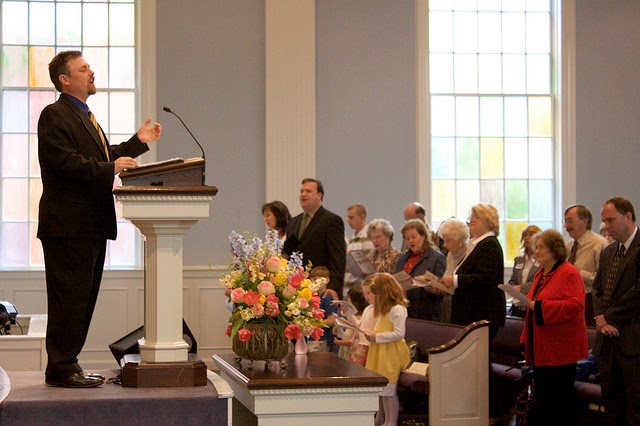
"… these forced communal chants make skeptics feel like an outcast for sitting out or a liar for playing along. "

Photo by Jason Wohlford, used without modification under a Creative Commons 2.0 License.
As I stop and reflect on what bothered me the most about religion, it was the lack of honesty with ourselves and the congregation. This was most glaringly apparent in the certainty with which we claimed to know that Presbyterian dogma was True. This had a euphemism: "faith."

Faith was held up as an ideal to achieve, and rational skepticism was shamed. People with reasonable doubts were described as "losing faith" or "struggling with faith." This euphemistic language is clearly intended to attach a negative stigma to the people honest enough to look with rational skepticism at the extraordinary claims which formed the foundation of Presbyterian beliefs.  Faith is a goal to achieve, meant to imply that it's not just okay, but actually good to claim to have certainty about things for which you have no evidence or rational justification to believe.

This frequent communal statement of certainty known as "the apostles Creed" was recited at each and every Presbyterian worship service I ever attended. Something about a large sanctuary filled with many hundreds of people saying the same thing helped make us doubters feel silly for our rational doubts. And I suppose that's the crux of my problem with religion. It works to quell rational doubts in its members by weekly shows of unity in belief. When this culture is part of a person's social networks, the idea of turning against the group becomes frightening at an instinctual level.

It's bad enough that the church tells people what to believe. What's worse is that they instruct the congregation to recite an affirmation of belief that is provided by the church. For years, as my parents dragged my skeptical ass to church, I felt dishonest for even playing along with this ruse. I won't go to church with them anymore because these forced communal chants make skeptics feel like an outcast for sitting out or a liar for playing along.


Monday, April 6, 2015

No Traumatic Experience Necessary For me to Leave Christianity

Hubble Pic from NASA Goddard.
I'm sure as a believer it might be easy to think that all the ex-Christians left because of some sort of abuse or trauma or other bad experience in the church.  For me, this couldn't be farther from the truth.  I had wonderful, meaningful, loving, beautiful experiences in the Presbyterian church. The minister was a close family friend. She was kind and loving and nurturing. Same with the youth group leader.

The only bad experience I had was gradually realizing that all my religious experience was just as easily explained as my imagination. Discovering that my beliefs reinforced themselves by making me feel the good feelings during prayer, worship, etc. When I found out that I could feel the same emotions as prayer when I imagined an intimate conversation with a close loved one.

Because once I realized that these experiences of bliss and joy and closeness to God could also be experienced in my imagination, it became painfully clear all my religious experiences were exactly that. The explanation was so much simpler. All the evil in the world now made sense. The absurdities of the OT, which so plainly conflict with observed reality melted away.

The world is simply as we see it. Rigid, unbreaking laws of physics resulting in beautifully complex structures and behaviors. No need for external interference, so why carry it along? I could write:

$$ F + G = ma + G $$

But the G is pointless. It has no bearing on the results of the equation, so we might as well drop it. It adds complexity to the model with no additional explanatory power.

$ F = ma $ for me.

…  Ok, $ F = \frac{dp}{dt} $ because that works better near the speed of light.

Sunday, April 5, 2015

Musings on LGBTQ Discrimination with the Religious Freedom Restoration Act (RFRA)

It's not the same as slavery. It's the same as  Jim Crow laws.  
Dear Christians: it's not a fucking "war." Nobody is trying to make churches illegal. The "war on Christianity" is an emotionally manipulative distortion of the truth meant to fire up your anger. Don't be played like a puppet. It's a lie. Lots of LGBTQ people are religious! (Sadly, IMO) 

Even the "scary evil" American Atheists and Freedom From Religion Foundation don't want churches to be illegal. They just want to defend our secular government so that the majority religion doesn't get preferential treatment. Just like it says in the first amendment and centuries of jurisprudence thereafter.  

 And frankly that's something even the most fervent religious zealot should agree with. Because the odds of our government picking THEIR particular sect of Christianity is vanishingly small. So the one government we all share must be fair and impartial.

Discrimination doesn't get a free pass for "minor" things like what events they'll cater or who gets to sit at the lunch counter. It doesn't matter if business owner is a bigot or a racist. That's the deal. If you want to run a for-profit business in this country, you follow the laws. And those include not acting on personal desires to discriminate. If you can't handle our country's antidiscrimination laws, Don't open a business!

The "Religious Freedom Restoration Act" is unconstitutional. Plain and simple. It's Jim Crow for LGBTQ community. And before you say, "But blacks can't hide their black identity and people can't tell who is LGBTQ!"   Remember that LGBTQ people shouldn't have to hide their identity.  Don't Ask Don't Tell is gone for a reason. It was discriminatory. When a gay or lesbian couple is out together, their identity is obvious. And they shouldn't have to hide it to avoid religions discrimination.

Saturday, April 4, 2015

Check Your Ego Before You Say Science is Wrong

Science is a process of constantly facing challenge by experts to validate the reliability of results and
conclusions. I trust the scientific process to reach the best possible answers on all matters to which it applies.
To suggest that a layman can out-think the international scientific community or has uncovered a "flaw" in scientific consensus is almost impossible. This happens most often when science is politicized: global warming, vaccines, and evolution come to mind.
There are many sources of cognitive bias to which we are all subject, but the relevant one here is called the "Dunning-Kruger" effect. Simply put, it states that before we understand a technical field, we are likely to underestimate its complexity and therefore overestimate our own abilities in the field. In short, it's arrogance -- unwarranted confidence in our own abilities.

So check your ego before you claim to know that science is wrong.

If the Bible Were Really Divine

Bible in Candlelight by Vishnu gs
If the Bible were truly inspired by a benevolent, omniscient god, it would be filled with advice that was valuable for the peoples and times that wrote it.  For example, we know that sanitation was a huge cause of death and disease in ancient times, up through much of the 1800s. A more plausible Leviticus would instruct the people to take the precautions that would have prevented the  plague:

1. thou shalt always wash thy hands with soap and water after thou poopeth. 2. for The Lord thy God hath made thy feces unclean and he shall make thee sick if thou breaketh this commandment. 3. Also shalt thou wash thine hands before thou consumeth food. 4. Before thou drinketh water, thou must boil it for 10 minutes. 5. For The Lord, thy God hath filled the world with teeny-tiny parasites that shall consumeth thee from thine insides if thou consumeth them with thine food or drink. 6. Praise be to God, maker of all things including disease and parasites

Amen.

It wouldn't even need to explain the germ theory of disease -- only demonstrate that the inspirational source of the book had knowledge of these things.

Friday, April 3, 2015

Religion is Like a Cathedral Built on a House of Cards

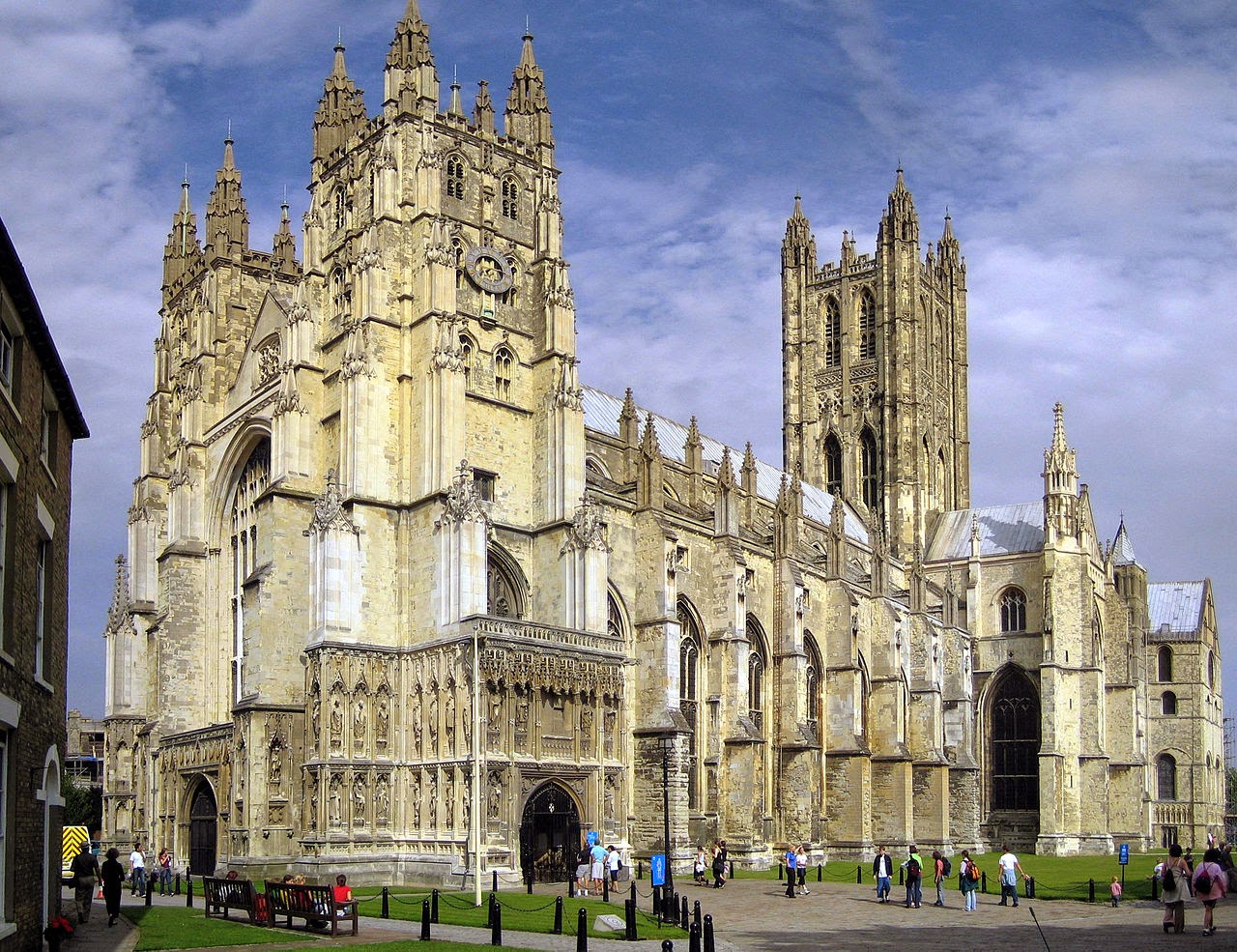
Note: If you're good with graphics, this is a very visual image analogy.  I'd love to have a better picture to illustrate it! 

"Canterbury Cathedral - Portal Nave Cross-spire" by Hans Musil.
This is a powerful analogy to explain why religion seems so beautiful to the believer but so patently absurd to a non-believer.  Whether you're on the inside or the outside makes a huge difference on your perspective.

What do I mean by this? When I was a Christian, I was on the inside of the Christian cathedral.  I admired the beautiful artwork on the walls, the complex network of hallways and sanctuaries.  Over hundreds of years, great minds had mapped and decorated the hallways of the Christian cathedral with such works as Dante's Inferno (1317), the ceiling of the Sistine Chapel (1512), and the Catholic Church's "Immaculate Conception" concept (1854).

Of course, there's some artwork in the Christian church that people disagree on: Joseph Smith's Book of Mormon (1830, older than "Immaculate Conception, by the way"), Cargo Cults (1885), Rastafarianism (1930).  People identify themselves by which of the many sanctuaries in the Christian Cathedral they worship in, which colors how they see the cathedral itself, almost to the point where it seems like they're in entirely different buildings.  Westboro Baptist would never associated with United Church of Christ, and they may not even admit they're in the same cathedral.

When I was on the inside of the Christian cathedral, I only associated with people who worshiped in nearby sanctuaries.  I didn't explore the whole cathedral, much less the outside. But in my late teens / early twenties, I learned about cognitive biases as sources of human error. The more I thought about it, the more I thought that all of Christianity might be well explained by these biases: Ambiguity effect, bandwagon effect, confirmation bias, congruence bias, gambler's fallacy, the observer-expectancy effect, the Semmelweis reflex, and subjective validation. There's a lot of ways we trick ourselves into believing things, and the Church seems designed to exploit them through weekly worship and structures which discourage challenging authority (AKA. blasphemy).

When I first started looking for objective reasons to believe my Christian upbringing, I believed it would be there, but I was careful not to leap to the conclusion I know I wanted to find.  I unknowingly used the outsider's test: Asking myself if I would accept each piece of evidence if it were presented to me for another religion like Islam or Hindu.

Taking the outsider's perspective was critical for me seeing my own religion for what it is: just one of many attempts by early man to explain the world around him.  By taking the outsider's perspective, I began to see the outside of the cathedral.  Still mostly looking up at its beauty, but more and more noticing problems with the foundation: "How could an all-powerful, all-knowing, and all-loving god allow evil?" and "How could such a god punish non-believers when their only crime was not seeing the evidence I was having troubles identifying myself?" I decided he couldn't.  That the only moral choice was to conclude that god would chose our destiny based on our behavior, not our beliefs.  I didn't know it, but in hindsight this conclusion was heresy.  And for good reason.  It took away my fear of exploring my faith more deeply and more critically.

As I tore away the facade that concealed the foundation of my religion's cathedral, I discovered there was nothing sturdy supporting it.  What I once saw as strong stone walls, unmovable and indestructible, I now understood were human constructs with no supporting physical evidence. Unable to support or withstand any modern test of their strength.  The walls inside the Christian cathedral can stand ONLY because nobody is allowed to test them.

On the inside, we were taught to look at them but never to test their strength by questioning their validity. Prayer worked. And when it didn't, that was because "we lacked the proper faith" or "God was testing us".  The weakness of the cathedral walls was explained away by instilling self-doubt.

We were taught to take the strength of the Christian dogma "On Faith". As if that was a good thing.