Sunday, November 29, 2015

The Holy Spirit told me God isn't real

Read the Bible to find a God
The Holy Spirit told me he God isn't real. "How can that be?," you might ask. Let's begin by discussing what people mean by "the Holy Spirit".
What is the Holy Spirit, and how can we know when it's talking to us?
I was going to share my personal opinions based on my experiences as a Christian, but that would only lead to charges that I'm wrong. Instead, I'll use some GotQuestions "answers" [Emphasis is my own]:
But how do we recognize the Spirit’s guidance? How do we discern between our own thoughts and His leading? After all, the Holy Spirit does not speak with audible words. Rather, He guides us through our own consciences (Romans 9:1) and other quiet, subtle ways. 
One of the most important ways to recognize the Holy Spirit’s guidance is to be familiar with God’s Word. The Bible is the ultimate source of wisdom about how we should live (2 Timothy 3:16), and believers are to search the Scriptures, meditate on them, and commit them to memory (Ephesians 6:17).
So what do I mean when I say "The Holy Spirit sold me God isn't real"? I mean that:

  • It's knowledge of the Bible that emerged from my conscience,
  • This knowledge was revealed to me over the course of months or years of routine study of the Bible as a believing Christian, and 
  • The revelation occurred as a series of smaller revelations, such that the entire faith was internally consistent at any one time.
    1. An loving and ethical God wouldn't punish me for thinking for myself. God is loving and ethical, so it's safe to think for myself. (This was the key to freedom)
    2. A fair assessment of biblical stories must include all reasonable explanations
      1. One potential explanation is that the people who wrote the bible were sincere but deceived
      2. Another explanation is that they were insincere
      3. Another is that the message was corrupted or manipulated during canonization
      4. Finally, there's a chance that a god with the omni's wrote it.
      5. There are a great many serious problems with that final hypothesis::
        1. If a God wrote the Bible, it really ought to be in agreement with the emerging discoveries of science rather than conflicting with them.
        2. A just and loving God wouldn't chose to ban shellfish and permit slavery
        3. An intelligent god would understand that we are rational creatures and require reasonable evidence to accept a claim.
      6. There are many reasons to believe the Bible could be sincere yet false
        1. Even in the modern era, it's common for people to interpret events inaccurately
        2. Much of the Bible (especially OT) is known to be pre-literate Jewish oral tradition.
        3. Even many of the NT Books are of unknown authorship or are written generations after the alleged events.
      7. When I stopped to reflect on the communications I'd had with God / Jesus, I realized
        1. They were never specific enough to make a prediction of an outcome
        2. They never provided me with objective insight which I didn't already have. 
        3. In these VERY REAL ways, my communications with "god" were not possible to distinguish from my own imagination.
    Of course, there's also this gem:
    Knowledge of God’s Word can help us to discern whether or not our desires come from the Holy Spirit. We must test our inclinations against Scripture—the Holy Spirit will never prod us to do anything contrary to God’s Word. If it conflicts with the Bible, then it is not from the Holy Spirit and should be ignored. 
    But what is "God's Word"? Obviously, they think it's the Bible (which version)? Other people think it's the Quran or the Book of Mormon or some other book.  But we all have seen how the Bible contradicts itself. A cursory review of the breadth of Christian denominations proves that one can read anything one wants into the Bible. It's like a Rorschach Test for believers. In any case, that's not a rational way to approach any test. Reasonable people recognize that the Bible they were handed was handled by men in the following chain from their hands:
    • Store
    • Delivery
    • Printer
    • Editor
    • Many hundreds of years (in some cases)
    • Translator
    • Many hundreds of years
    • Canon selection (allegedly divine, impossible to verify)
    • Original Author (mostly anonymous)
    • Source material (allegedly divine, impossible to verify)
    So when it comes down to it, we realize that the book we hold in our hands could have been corrupted in ANY of the preceding steps (some more likely than others). Two of the steps are so fraught with potential error that theists are taught to believe divine intervention somehow protected the Biblical word.  Returning to GotQuestions:
    ... he who searches our hearts knows the mind of the Spirit, because the Spirit intercedes for the saints in accordance with God’s will” (Romans 8:26–27).
    In any case, the end result is that we know it's god or the holy spirit because you're studying scripture, or praying, it feels real, and it agrees with scripture -- something poetic and open to many interpretations. In talking to many Christians, it came across that God or the Holy Spirit were talking when things were suddenly clear and understandable.  This was the measure Christians seem to tend actually to use.
    As I reached the age of reason, I studied the Christian teachings I'd been taught as a child. I searched my soul to understand the ethics of the God / Jesus model I had been taught. Some things became clear:
    • A just God wouldn't torture for disbelief due to missing evidence. In a just system, deeds must be the basis of reward and punishment, not beliefs.
    • The Jesus I was taught to believe in was not hateful or discriminatory, and certainly didn't lash out for honest mistakes. The fire and brimstone preachers were caught up in their own personal anger and projecting it onto their version of god.
    The clarity of these personal revelations was convincing evidence of their divinity to my Christian self. They made it possible for me to think openly about the strength of the evidence for the things I was taught to believe as a child.  I didn't need to worry about torture because God is just and wouldn't torture without reasonable cause. 
    In short, a rational review of the reasons for by beliefs helped me recognize the circular logic and simple collection of human cognitive frailties which lead to and reinforce superstitious beliefs. Central to those are the power of community belief, and confirmation bias. But surely there must be evidence of god which stands up to scrutiny that accounts for these cognitive biases!
    There wasn't. I looked and didn't find it in any of the places I expected to. Of course, I heard that "Absence of evidence isn't evidence of absence", but given the superstitious nature of early people, I couldn't shake the possibility that my religion was just as much a superstition as all the others.
    I was atheist for decades before I really even knew the word, much less found authors or community.  There wasn't a sudden switch, but a gradual increase in my doubt for god. Example after example showed that God was no more likely than other mythical creatures.  
    • Intercessory Prayer (Prayer for others) [FAIL]
    • Better health of believers [FAIL]
    • Trustworthy clergy [FAIL]
    • Miracles [FAIL]
    • Firmament and heaven up in the sky [FAIL]
    • Genetics or archeology to confirm any ancient books [FAIL]
    One by one, the loving interventionist god I'd been raised to trust fell to the cold hart facts of reality: These things don't happen. People interpret any little positive thing as god, and ignore the negatives. True interventions that align with any objective and intelligent purpose simply don't happen.
    If God is real, it has no detectable interaction with reality which I've been able to uncover. And belief without reason is unhealthy.
    Maybe I'll meet a  god some day.  I doubt it, but if I do and it's ethical and benevolent, it will understand and accept my nonbelief.

    Saturday, November 28, 2015

    Thoughts on Christian Terrorism in the Black Friday Planned Parenthood Murders

    While I would never presume to know before the facts are all in, past statistics and demographics leave very little question as to which religion inspired the terror attacks on a Planned Parenthood health care clinic yesterday.
    Suspected mass-murderer Robert Dear's mug shot.
    Wildly exaggerated stories about "selling body parts" and exaggerated rhetoric like "murdering babies" from a supposed Pro-Life movement are likely contributors. These are the rhetorical tactics of a group which for good reason cannot form a coherent constitutional argument for why it has the right to impose its religious laws on other people's bodies.
    Just like radical Islam, a radicalized Christian lashed out with indiscriminate violence at anyone he saw as part of the "Planned Parenthood evil". The lies and distortions of the radicalized "pro-life" Christian movement are to blame. There are real-world consequences to irresponsible use of violent rhetoric.


    Monday, September 28, 2015

    Help for Those who Struggle with Faith

    Doubt
    Are you "struggling with faith"? Trying to figure out how it is that Christianity seems to make sense to so many people?  The miracles and supernatural just doesn't ever happen in reality, and you can't help but notice that ancient cultures weren't the best at interpreting the things they saw happening around them.

    I have great news. You don't have to struggle with it any more! There's an easy way to be done with the struggle for good.  What's more, by never struggling with your faith again, you can live a life that's even more free and fulfilling you ever imagined. You'll never wonder why bad things happen to good people or why God created cancer and malaria.

    First, we need to carefully understand the problem itself.  "Struggling with faith" is negative language. It makes people feel shame and guilt over your reasonable doubts. A more neutral phrase might be "doubting your deeply held beliefs."   Put this way, it's not so negative, is it?

    Doubts are a natural reaction when we're asked to believe something incredible without supporting evidence. There's nothing wrong with your doubts. In fact, they're very healthy. You would insist on reasonable evidence for any other belief in your life.  In fact, it would be unfair or dishonest to give your religious beliefs a free-pass.

    Most people learn their religion as a young child.  They accepted stories as truthful before they had the critical thinking skills to fairly evaluate the claims. This isn't just true for Christianity. It's broadly true for all religious beliefs. Now that you're an adult and you've learned to evaluate things rationally, you're entitled to reevaluate.

    So what will you find when you rethink things? What conclusions are you willing to accept? Can you give yourself permission to reach the scary conclusion? It's okay if you discover you were wrong all this time.  You're not bound to your religion by some kind of curse. You can change your mind and keep all the values that are important to you. You work ethic, love, and honesty aren't your religion's values. They're your values. You can keep them.

    So how do you put an end to your struggles with faith? It's pretty simple. Stop struggling. Let go of the obligation to believe what your parents taught you. You have the right, even the obligation to figure out what's true for yourself. And it's okay if you reach a different conclusion.

    So congratulations for your new-found doubt. Congratulations for bravely questioning the things you've always just assumed.  And congratulations for giving yourself permission to reach whatever conclusion is rational.

    Saturday, September 26, 2015

    Response to Ohio TRAP laws to limit Abortion access

    Here's the letter I've written to my Ohio Senator and Representative regarding the state refusal to license local abortion providers.

    Mr. X, 

    I'm writing to express my sincere concern about how the state of Ohio is limiting my family's access to healthcare. If my wife were to have an ectopic pregnancy or any other condition where the ethical choice is to terminate the pregnancy, our access to abortion care is being severely limited by irresponsible and invasive Big Government decisions intended to limit access to abortion services. The legislation driving these changes is reckless, irresponsible, and unethical. Please understand that this situation needs to be rectified immediately.

    Wednesday, September 9, 2015

    Towards an Objective Assessment of Scriptural Prophecy

    Introduction
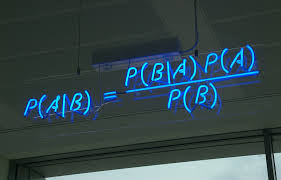
    I want this neon sign!

    I've poked at prophecy in the past. I assert that it's better explained as post-hoc favorable interpretation than as legitimate future-telling. A Christian asked me to expand on how we can apply Bayes' Theorem to prophecy.  On the surface, this seems like a trivial task, but it turns out to become pretty murky since the likelihoods of the various events are very hard to quantify. Nevertheless, I think it's instructive to consider.

    Background

    Bayes' Theorem is a theorem in probability and statistics which computes the likelihood of related events given some assumptions.  In its simplest form, it states:

    $ P(A|B) = \frac{P(B|A) P(A)}{ P(B) }  $

    Where P(x) is the probability of x being true, and P(x|y) is the probability of x being true, assuming that y is true.  x and y being events or observations.

    Method

    For starters, let's consider what I think is the meat of prophecies: That they support the claim of divine and infallible nature of a holy book. Let us ask Bayes, "What is the probability that a holy book is divine ($div$) given that a prophecy it contains is true ($pro$)." That is to say:

    $ P(div|pro) = \frac{P(pro|div) P(div)}{ P(pro) }  $

    I'm not sure if we'll be able to get very far, but let's dive in, shall we? 

    Divinity Yields Accurate Prophecy?

    $P(pro|div)$
    What is the chance that a prophecy will be true in a divine book?  That depends on who you ask and what you assume for the nature of the divinity which inspired the book.  That being said, be careful what you apply to this probability.  Too low and the $ P(div|pro) $ approaches zero.  Too high and a failed prophecy will prove the Bible isn't divine.

    Likelihood of Divinity

    $P(div)$
    What is the chance that a particular holy book is divine without any other assumptions?  Again, this depends dramatically on the incoming assumptions about the holy book in question. 
    • Many presuppositionalists enter the discussion with $ P(div)  = 1 $. 
    • If you assume that one book is divine among all titles ever written, your value for $ P(div) $ is very close to 0.  
    • If you assume that of the four holy books (Torah, Bible, Quran, and Book of Mormon), one and only one is divine, you get $ P(div) = 0.25 $ 
    To be honest, I'm not satisfied with any of these answers.  All of them are pretty arbitrary given that we have no way of knowing if or how often books are divine.  

    Likelihood of Prophecy being True

    $ P(pro) $ 
    What is the likelihood of the prophecy coming true without any assumptions about the divinity of the book in question? In evaluating this likelihood, it's important to consider:
    1. If people believing the book is divine will make the prophecy more or less likely to come true
    2. The likelihood that the event would happen anyways
    In other words, to determine if the prophecy is true, we must consider it in the context of the events we know to be true

    $P(pro|evt) = \frac{P(evt|pro) P(pro)}{ P(evt) }  $

    $P(evt)$ in the denominator means that if the event would be likely to happen anyways ("There will be wars and famine and disease!!!") then the prophecy isn't likely to be true.

    $P(pro)$ in the numerator means you have to guess at the likelihood of the specific prophecy being true. I'm not sure how to estimate this value. Perhaps this could be done by comparing it to other prophecies in the book?

    $ P(evt|pro) $ is the probability of the specific events, given that the prophecy is true. Again, this is very subjective, but it means you must clearly define what your "event" is and assess its likelihood given the prophecy being true.  If there are other ways of fulfilling the prophecy, they reduce this likelihood.

    Discussion

    I'm not going to drag you all the way through a specific example.  My intention in this post is to communicate the various terms that need to be considered when assessing the likelihood of a book's divinity given that a prophecy is true. Hope this helps.

    Extra Credit

    Suppose we believed that $P(div) = 1$ and $P(pro|div) = 1$. Show that $P(pro)$ must be equal to unity and that therefore ANY prophecy which can be shown to be false proves the assumptions are wrong -- either the Bible is not divine or the divine agent produces false prophecies.

    Tuesday, September 1, 2015

    Speaking for God

    I've spent over year now debating theology with Christians and Muslims. One thing that's constant is that they'll make a claim about God without an ability to back it up. Then they get upset when I tell them the claim is baseless. Yet they cannot point to an objective fact or means to validate their claims.

    In a nutshell, this is one of the foundational problems with religion: In religion, the church is created to represent an absentee God for the believer. Since nobody can communicate with God, your church, synagogue, or mosque tells you what he is like and what he wants from you.

    At this point, some religious believers might be thinking "that's not true! The [Name of holy book] is the word of God!" But of course, that holy book simply supports or is supported by the aforementioned religious organization. Regardless of the religion, there are many different interpretations of the holy book which quibble over details ranging from acceptance of gays to the divinity of Jesus or Mohammed. Of course none of the beliefs are based in objective evidence, so it's impossible to resolve these disagreements. The disagreeing groups simply aren't equipped with (or aren't willing to use) the critical thinking skills necessary to resolve their disagreement. They seem unable to even see the foundational epistemological failures that explain why their groups cannot agree.

    The process by which churches make these claims about the nature and desires of God is gradual and subtle. It's done through sermons, songs, and discussions with other church members who also accept the dogma. Through this process, religion is helping to define the believer's expectations for what God is like. When the believer then communicate with God through "prayer," their mind forms plausible responses from this shared vision of God. Humans are VERY good at imagining conversations. The imagined interlocutor is convincing enough that people believe their imagined God might be real.  Of course they're prepared for this delusion by being taught they need to "listen carefully" and "God will speak to them." This handy guide provides a nice template for how the delusion is cultivated.

    First, Christians should build relationships with other Christians
    The belief spreads best if you're surrounded by people who support your belief.  Since there's no objective evidence, developing a social group is the best way to convince yourself.
    A Christ follower should spend daily time reading the Bible, mulling over the messa and praying for ways to make scripture’s lessons into a lifestyle. 
    Repetition and meditation helps solidify a common belief
    By adding prayer for others and himself to this daily quiet time, the Christian will find it easier to turn away from their own self-focused desires, and advance God’s priorities to first place. 
    Believing they're helping other people helps believers feel like this repetitive action isn't as selfish as it really is,
     Christians should actively seek opportunities to tell others about what they are learning from and about God.
    The best way to follow through with a commitment is to publicly affirm it.  This makes the believer be more committed to the beliefs. Turning away from the commitment after publicly affirming it is socially awkward.  To avoid this embarrassment, a believer will tend to shun any self-doubt. or at the very least conceal this doubt from fellow believers. The end-result is a community which can more strongly reinforce the religious dogma of the sect.

    It is through this mechanism that these God beliefs flourish. Each believer thinks theirs seems rational because they're surrounded by people with nearly identical beliefs. The belief which cannot be supported by any rational or objective means is supported by the echo chamber of the social group instead. When confronted with a differing belief or a different religion, there's no way to resolve the different subject of gods each group has independently created.  

    So what happens? Christian theologians review Muslim work and find all the logical and factual flaws in their religion and say, "Ha ha Islam is false!" But of course, Muslim scholars do the same for Christianity. The leaders of each religion are capable of critical thought and logical evaluation of other beliefs. But for their own favorite belief, they're unable or unwilling to apply the same standards. This is the part that I don't understand.  

    How can intelligent people be oblivious to their own double-standard? I suppose it takes effort to evaluate one's own deeply held beliefs, but that's an essential part of being an honest person.

    Tuesday, August 18, 2015

    Year in the Bible - Super Secret Edition [Working Draft]


    Wouldn't it be neat to publish a Bible devotional in a tabloid style?

    The Bible is a powerful force for atheism

    Year In The Bible

    Super Secret Edition

    Scandalous Bible Verses Your Preachers Hopes You Never Discover

    Monthly Themes:

    1. Convincing believers not to question religious authority -- even when it's absurd
      1. A fool says in his heart
      2. The story of Thomas
      3. 1 Chorinthians I
      4. Kill apostates and non-believers (if you doubt, don't tell!)
    2. Mobster-Style Blind Loyalty
      1. Job
      2. Lot
      3. Abraham and Isaac

    3. Magical Creatures (March)
      1. Unicorns
      2. Fire-breathing Dragons
      3. Living in a fish
      4. Satyrs
      5. Revelation stuff
      6. Talking Snakes
      7. Talking Donkeys
      8. Burning Bushes
    4. Learning and Cooperation is bad
      1. Tree of Knowledge
      2. Tower of Babel
      3. John 4 - Jesus Learnin'
      4. ?
    5. Broken Morality
      1. Stoning Children
      2. Passover
      3. Stoning non-virgins
      4. Polyamory - King concubines
      5. Slavery
    6. Mistreatment of Women
      1. Stoning non-virgins
      2. Lot's wife
      3. Daughter sacrifice for battle victory
      4. Keep virgins for yourselves
      5. Lot's daughters
    7. God Makes Mistakes
      1. Adam and Eve
      2. Noah's Ark
      3. Satan
      4. Broken word